
How Dancers Choose Their Stage Names
Every dancer in Vienna works under a name that is not hers, and the choice is rarely as casual as it looks. A stage name is a working tool: it has to be pronounceable by an international clientele, memorable after two drinks, unclaimed by anybody else in the house, and above all it has to keep a private life private. Most performers get there after several attempts, and the ones who chose badly usually know it.
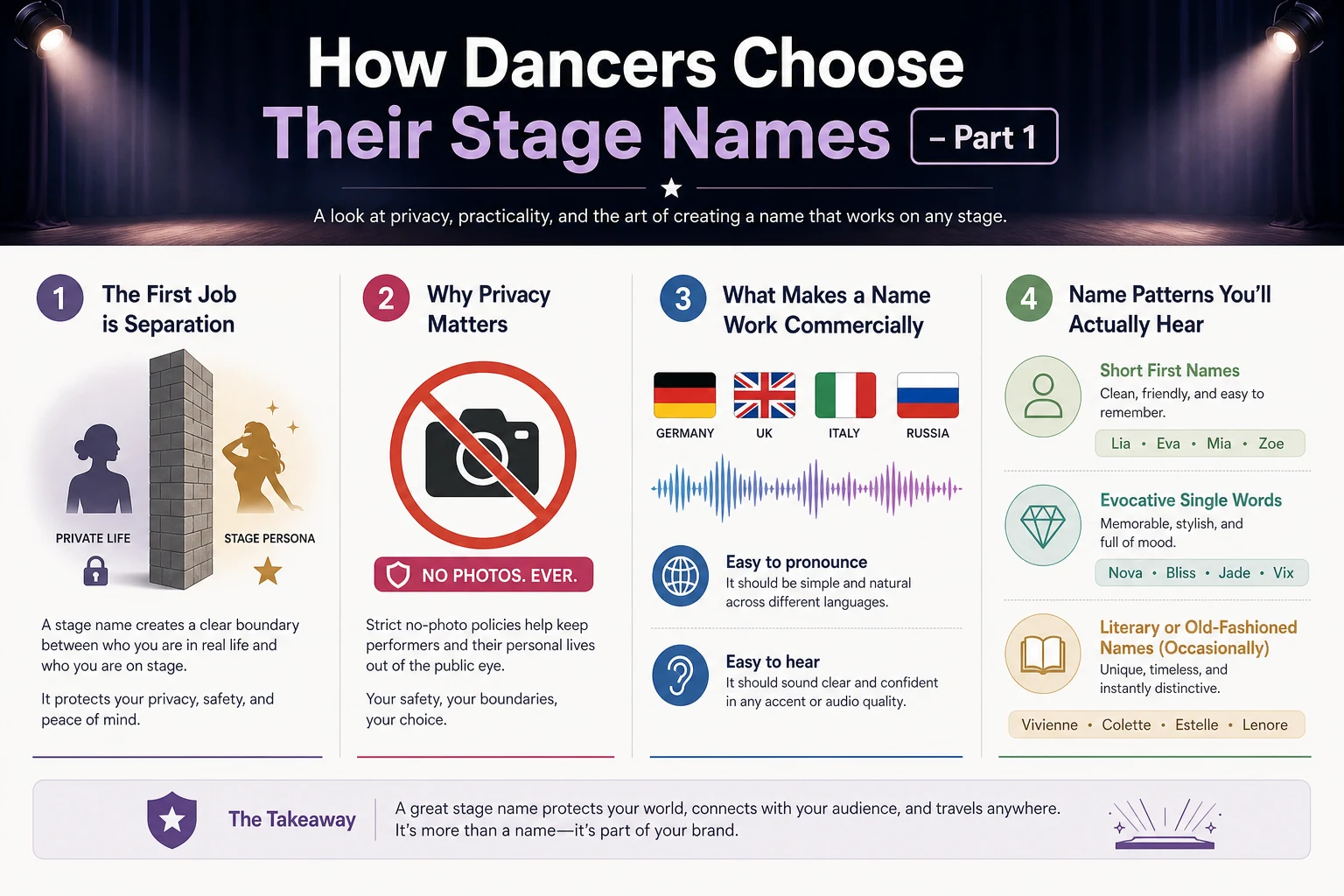
The first job is separation
The primary function of the name has nothing to do with glamour. It builds a wall between the person who goes home at four in the morning and the person guests met at midnight. That wall protects family relationships, future employment, housing and simple peace of mind, and it is the reason nobody in a serious house asks a colleague’s real name on the floor. The same discretion runs through the whole sector, and how it is maintained in practice is described in how a visit stays confidential.
It is also why a camera is treated as a genuine threat rather than an irritation: a photograph defeats a stage name instantly and permanently. The reasoning behind the strict device rules is set out in why some Vienna strip clubs ban phones completely.
What makes a name work commercially
Four practical tests. It has to be easy to say for guests who may speak German, English, Italian or Russian. It has to survive a noisy room, which favours two syllables and clear consonants. It has to be distinct from every other name currently working in the same house. And it should suit the persona the performer actually wants to project, rather than one she will get tired of by the second week.
Those requirements are professional rather than decorative, and they sit alongside the other craft elements of the job described in the skills a dancer needs to succeed. The name is part of the product, and a good one does measurable work.
The patterns you will actually hear
Short international first names are the most common choice, because they are frictionless in every language. Single-word evocative names are the second pattern, usually chosen for a persona rather than a personality. Occasionally there are deliberately old-fashioned or literary names, which work precisely because they are unexpected in this setting.
What you will not often hear is anything hard to spell or heavily local, for the obvious reason that a name nobody can repeat is a name nobody asks for again. In a house with an international clientele, the constraint is entirely practical.
Who has a say
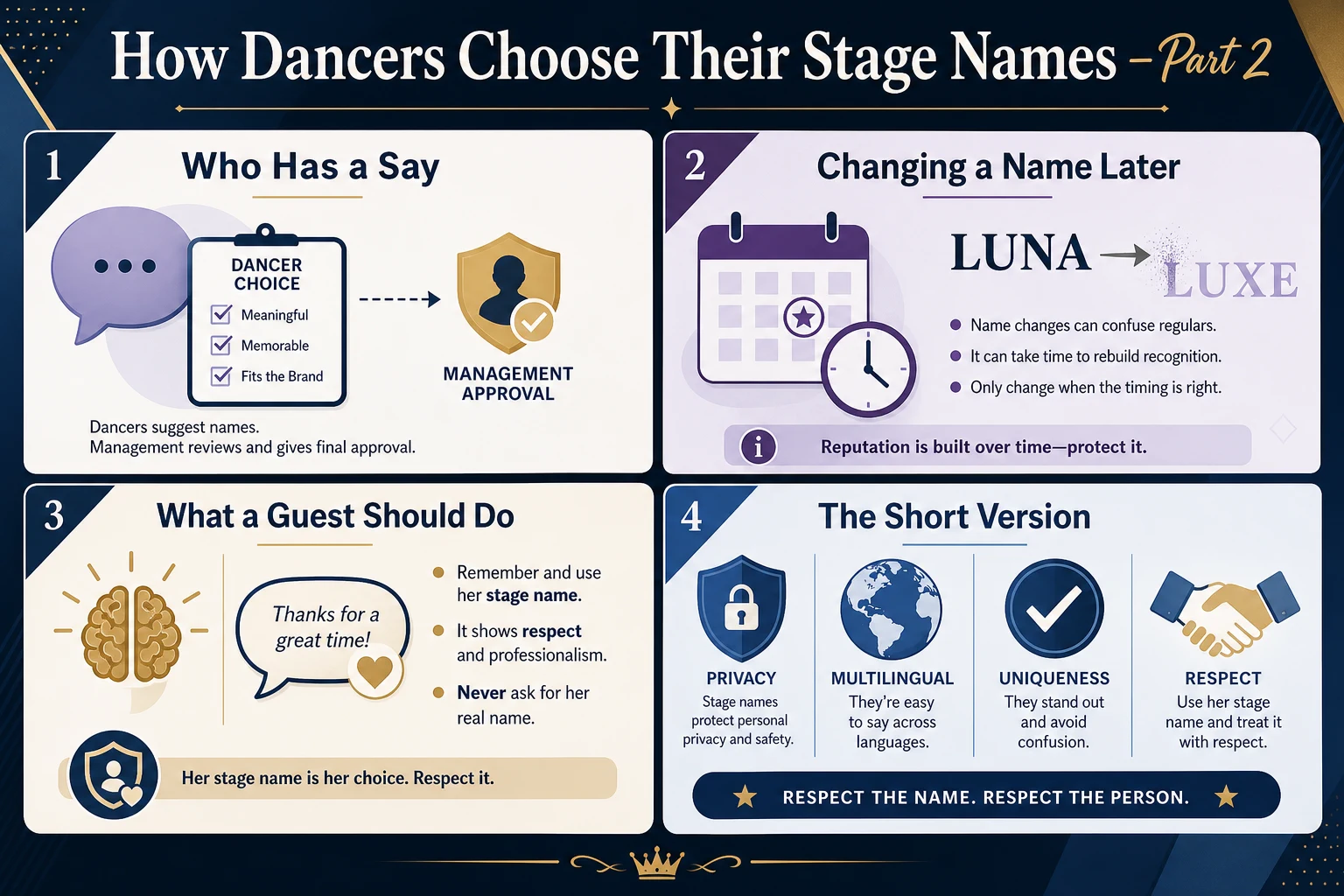
Usually the dancer, sometimes with a nudge from management. Clubs care about collisions, because two performers with similar names in the same room creates confusion in bookings, in tips and in conversation. Where a house keeps a roster, the name is checked against it before it goes into use.
Beyond that, most managers are indifferent to the aesthetics and interested only in whether the name is workable. That combination of professional coordination and personal choice is visible in how these houses are organised generally, including behind the scenes, as described in what happens backstage in a Vienna strip club.
Changing a name later
It happens, and it costs something. Regulars know a name, ask for it, and recommend it to friends, so changing it means giving up an established reputation inside a house. Performers usually change names when they move city or venue, which is the natural moment: the regulars do not follow, so the loss is already priced in.
Career moves inside the scene involve the same kind of calculation, including the shift some performers weigh towards other formats, which is discussed frankly in switching from striptease to sex work in Vienna.
What a guest should do with the name
Use it, remember it, and never ask for the one behind it. Asking a performer her real name is the most common small intrusion in this business, and it is understood exactly as it is meant even when it is meant kindly. The answer will be polite and it will not be true, which is the correct answer.
Remembering a name between visits, on the other hand, is genuinely appreciated, and it is one of the cheapest things a guest can do well. It belongs to the same practical etiquette as everything else in how to behave around dancers in a Vienna strip club.
The short version
A stage name is a working tool with one primary job: keeping a private life separate from a public one. Commercially it has to be pronounceable across languages, audible in a loud room, unique within the house and suited to a persona that will last. Short international names dominate for exactly those reasons.
The dancer normally chooses, management checks for collisions, and changing a name later means surrendering an established reputation, which is why it usually happens alongside a move. As a guest, use the name, remember it, and never ask what is behind it.