
How a Strip Club Music Set Is Built, and Why the Order Matters
Nobody walks into a strip club to hear the playlist, and yet the playlist is one of the most deliberate things in the building. The order of the tracks decides how a dancer’s set is structured, how long the room stays attentive, when the bar gets busy and when the floor empties. Get it right and the evening has a rhythm nobody consciously notices. Get it wrong and the whole room feels off without anybody being able to say why.
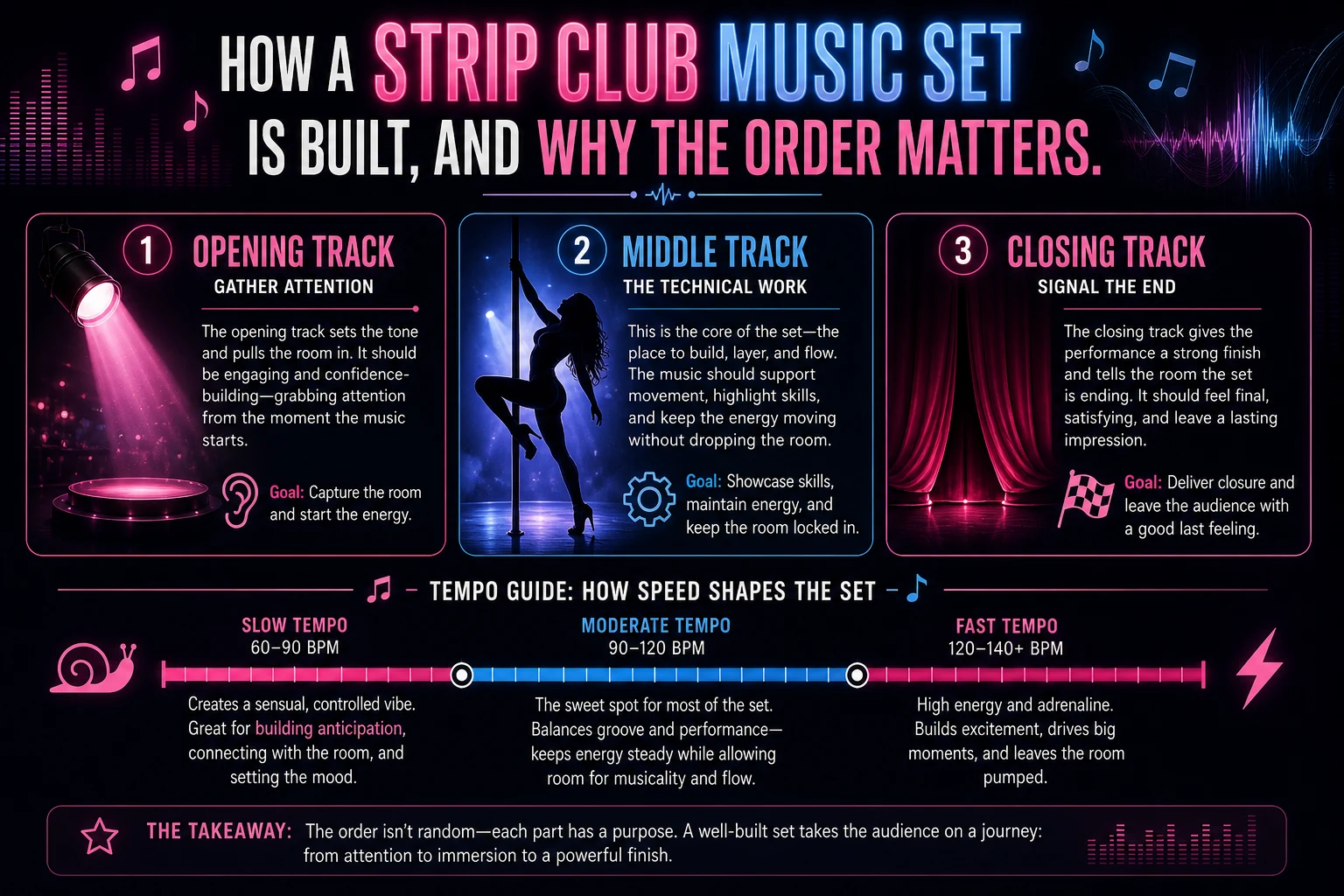
A set is built in three parts
Most stage sets in Vienna follow the same shape: an opening track that establishes presence, a middle track where the actual work happens, and a closing track that resolves it. The number varies between houses, but the structure rarely does, because it mirrors how attention behaves. A room needs a few seconds to look up, a while to watch properly, and a clear signal that the performance has ended.
Everything a dancer does is fitted into that arc, and the physical demands increase sharply through it. The strength and technique this requires is the least discussed part of the profession, and it is covered honestly in the skills a dancer needs to succeed in Vienna’s clubs.
Tempo is a working tool, not a taste
Slow tracks make pole work legible and floor work possible; fast tracks make it look frantic and hide the technique. That is why the most impressive stage moments in this business usually happen at moderate tempos rather than at the energy peak of a song. A set built entirely from club bangers is exhausting to perform and surprisingly boring to watch.
Dancers who choose their own music tend to pick a slower second track than an audience would expect, and they are right to. The effect that produces on the watching side is part of what the discussion in why striptease is so exciting for men circles around: anticipation is built by pacing, not by volume.
Who actually chooses
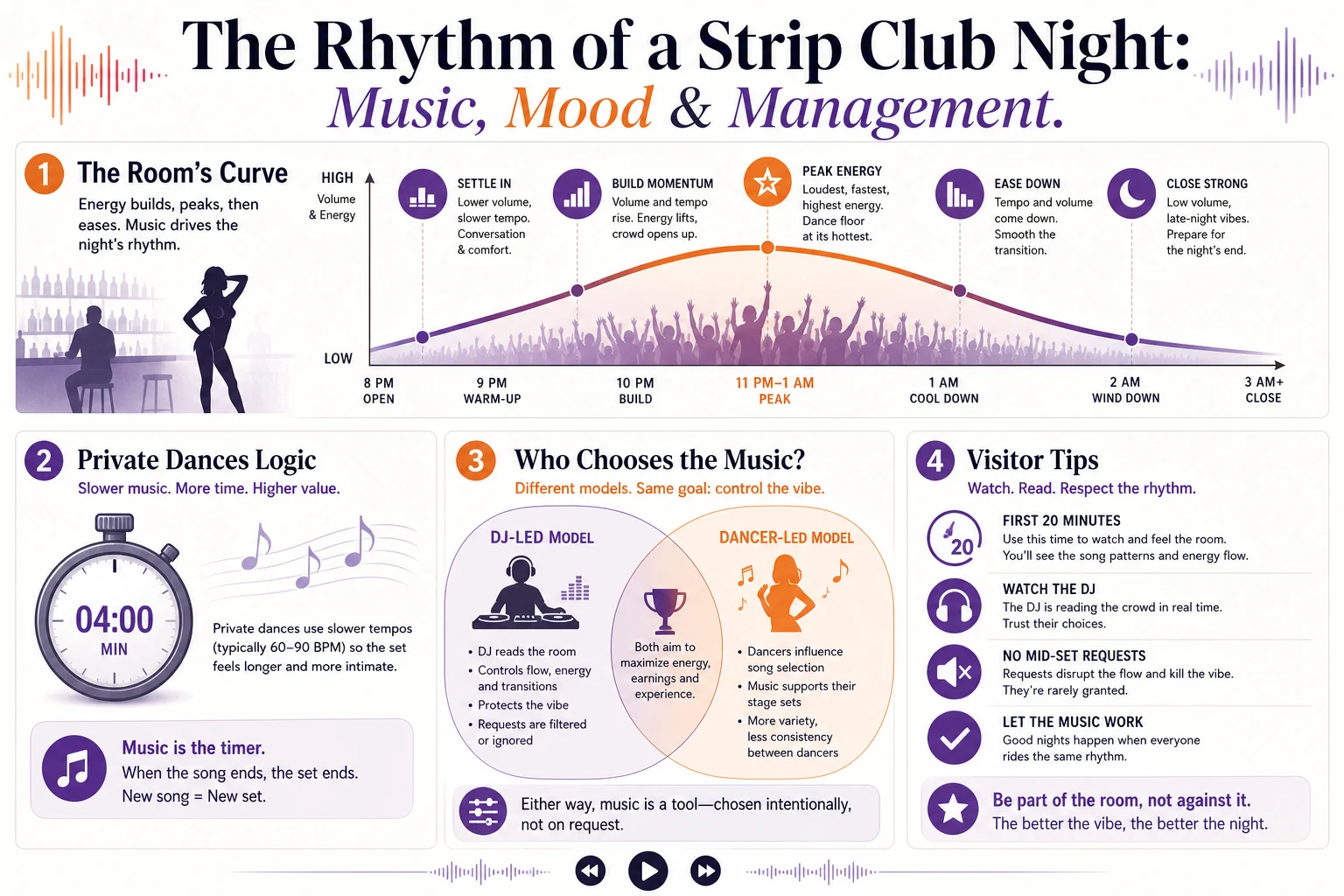
Practice varies by house. In some clubs the DJ or the manager controls the entire night and dancers fit into it; in others each performer brings her own two or three tracks and the DJ sequences them. Larger venues with a permanent DJ lean towards the first model, because a coherent night matters more than any individual set.
Either way there is a running negotiation between the stage and the floor, and it is one of the small professional relationships that make a club work. A house where the DJ ignores the dancers is a house with a visible problem, and it is the sort of thing an experienced visitor notices without knowing what he noticed.
The room has a curve, and the music follows it
Early in the evening the music is quieter and slower, because a half-empty room amplified sounds desperate. As the floor fills, tempo and volume rise together. Around the busiest point the set list is at its most energetic, and then it tapers deliberately, because a room that is being wound down buys fewer drinks and goes home more calmly.
That last part is commercially significant. Music that stays at peak intensity until the lights come up leaves guests wired and argumentative at exactly the moment bills are being settled. The best houses use the final half hour to lower everybody’s pulse, which is the same craft the sex bars apply, as described in how lighting and music shape the mood.
Private dances have their own logic
Away from the stage, music becomes a timer as well as an atmosphere. Where private time is priced by the song, the track length literally defines the product, which is why so many clubs moved to fixed minutes instead. Either way, the music in the private area is usually slower and quieter than on the floor, for practical reasons: conversation has to be possible.
If you are being offered a booking measured in songs, it is worth knowing what that actually buys, and the variables are set out in how much a private dance costs and what changes the price.
What a visitor can do with this
Two practical things. First, judge a club by the first twenty minutes of its music rather than by its peak: a house that plays thoughtfully to a quiet room is a house that pays attention generally. Second, if the stage set is clearly structured and the DJ is watching the performer, you are in a venue that takes its own product seriously.
And one thing not to do: requesting a track for a dancer mid-set. It reads as helpful and lands as an interruption, which puts it firmly among the habits listed in how to behave around dancers.
The short version
A strip club set is built as an arc: an opening that gathers attention, a middle where the technical work happens, and a close that releases the room. Tempo is a tool rather than a preference, and moderate tempos show technique better than fast ones. Across the night the music tracks the room’s own curve, rising with the crowd and tapering deliberately before closing.
Who chooses the tracks varies by house, and the relationship between the DJ and the dancers is a reliable indicator of how well a club is run. As a visitor, listen to the first twenty minutes, notice whether anybody is paying attention to the stage, and do not request songs mid-set.