How the Money Flows in a Vienna Strip Club
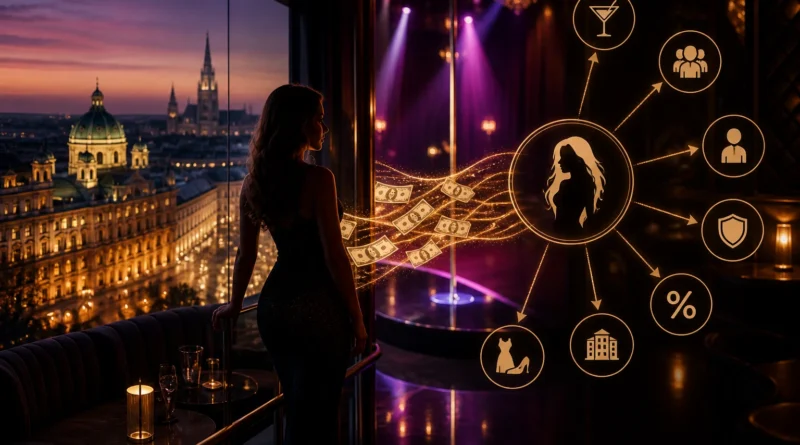
A strip club looks like a simple business from a bar stool: guests pay, dancers dance, the house takes its cut. The reality is a set of separate money streams that barely touch each other, and the shape of them explains almost everything that puzzles visitors, from why entry is charged at all to why a dancer cares more about one kind of booking than another. None of it is secret. It is just never explained at the door.
Stream one: the door
Entry money, or a minimum consumption, belongs to the house and covers the fixed cost of existing: rent, licence, security, cleaning, the DJ, the lighting rig and the staff who are paid whether the room is full or empty. It is the least popular charge in the building and the most structurally necessary one.
Clubs that waive it usually recover the money elsewhere, most often in drink prices, which is why comparing venues on entry alone is misleading. The full arithmetic of a visit is laid out in how much a private dance costs and what changes the price, and the door is only the first line of it.
Stream two: the bar
Drinks are the house’s main income in most Vienna venues, including those with a strong stage programme. This is the single most useful thing a visitor can understand, because it explains the entire social architecture of the room: the seating, the service pace, and the fact that company tends to arrive with a suggestion.
A drink bought for a dancer is bar income, not her fee, though in many houses she receives a share of it. That share is exactly why the suggestion exists, and knowing this removes the awkwardness from it: nobody is tricking you, you are being invited into the club’s business model. The same mechanism operates in the city’s sex bars, described in why drink menus differ between premium and basic bars.
Stream three: private dances
Private time is where the split between house and performer becomes explicit. Models differ: some clubs take a percentage of each booking, some charge dancers a fixed nightly fee and let them keep their bookings, and plenty run a hybrid. What matters to a visitor is that this stream is priced per booking and tracked, and therefore is the one place where ambiguity costs real money.
Because the arrangement varies by house, the terminology does too, and the words do not carry the same meaning across the street. That is the whole argument of what table dance, lap dance and pole show actually mean in Vienna.
Stream four: tips
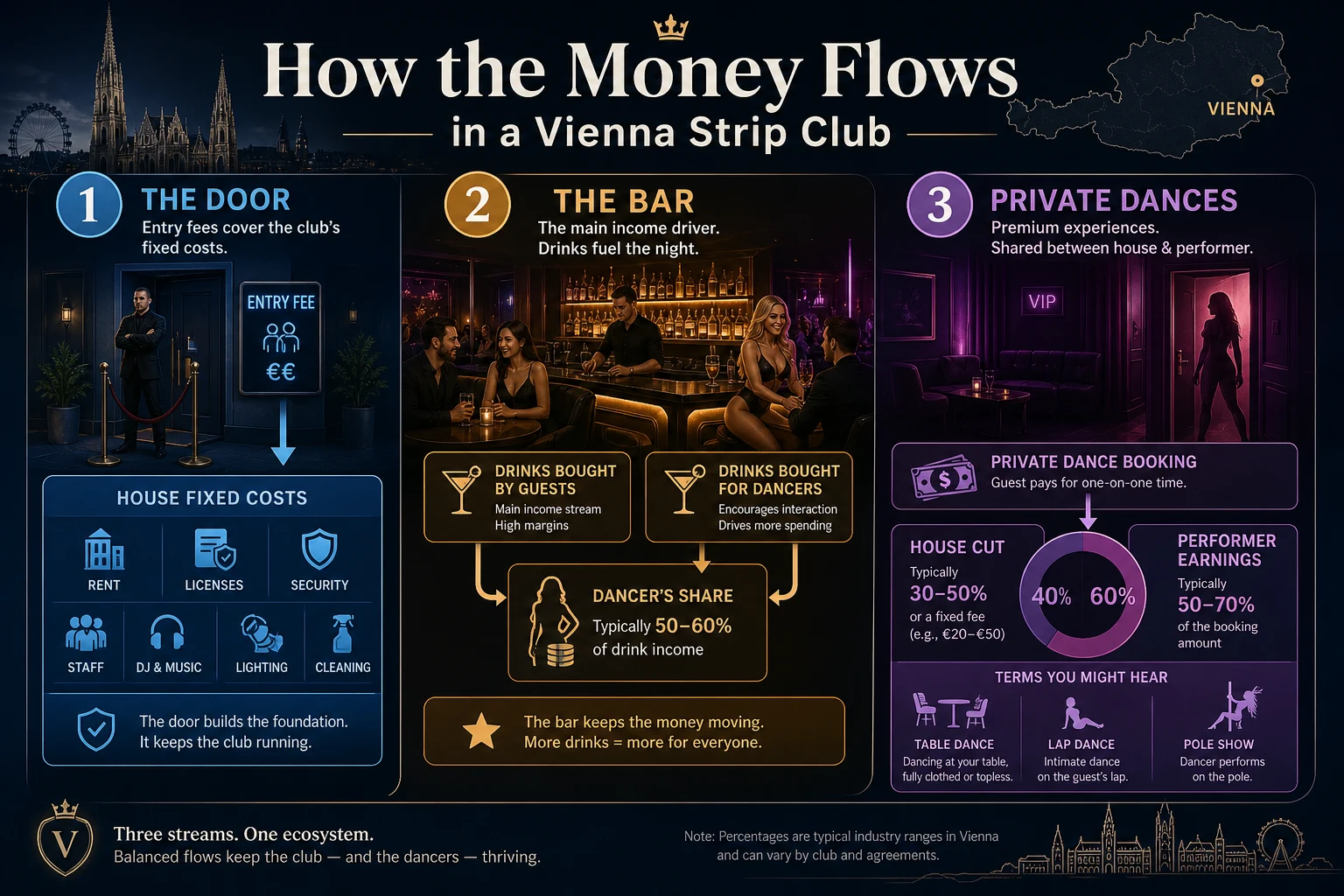
Tips go to the person, not the house, and they are the most direct transfer in the building. In Vienna they are customary rather than compulsory, which surprises visitors arriving with American expectations and equally surprises those who assume nothing is expected at all.
The practical question of how much and when is worth getting right, because a badly handled tip is more awkward than no tip. It also interacts with the etiquette of the room generally, which is the subject of how to behave around dancers in a Vienna strip club.
Where the dancers actually earn
Add the streams up from the other side of the stage and the picture inverts. Stage sets build the room’s atmosphere but rarely pay much directly; private bookings and drink shares are where the evening is made. That is why a dancer will spend more of her shift talking than performing, and why she treats a long conversation as work rather than as a break from it.
It also explains career movement inside the scene, including the shift some performers consider towards other formats, discussed candidly in switching from striptease to sex work in Vienna. The money structure, not the glamour, drives most of those decisions.
Why the streams stay separate
Keeping the door, the bar, the bookings and the tips in separate channels is what makes a licensed club auditable, and auditability is what keeps a licence. It also protects the guest: a bill with distinct lines is checkable, while a single improvised total is not.
The wider regulatory frame is public, and the City of Vienna maintains its own information pages for the licensed sector at the City of Vienna’s prostitution information service. A venue operating outside that frame has no reason to keep any of these streams tidy, which is precisely why the tidiness is worth checking.
The short version
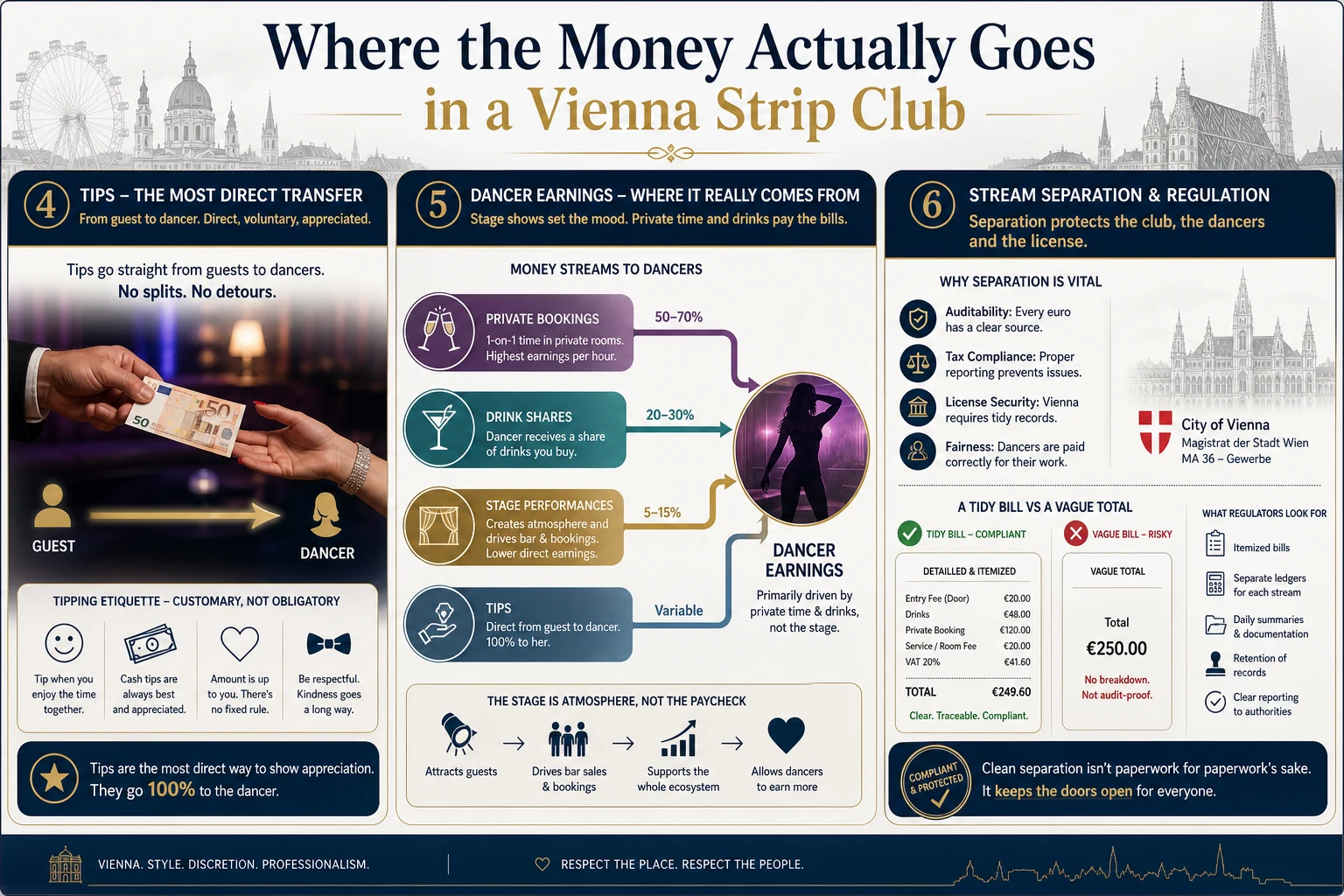
Four streams run through a Vienna strip club. The door covers fixed costs and belongs to the house. The bar is the main income and explains the entire social layout of the room, including drinks bought for company. Private bookings are split between house and performer on terms that differ by venue. Tips go directly to the person.
From the stage side, bookings and drink shares are where the money is, not the stage set, which is why conversation is work. Separate, itemised streams are a sign of a properly run licensed house, and a single vague total at the end of the night is the clearest warning you will get.